How to Choose a Compression System
Why "FDA registered" means less than it sounds, and the questions that get a straight answer.

This guide is written for two readers. If you are buying a system for yourself, sections one through five are the whole decision. If it is going to a team, gym, studio or clinic, section six is the one nobody writes for you. It covers pneumatic compression systems: a control unit that inflates sleeves around the legs, and sometimes the hips and arms. Everything here is about evaluating equipment. None of it is medical advice. If you have a circulatory condition or a blood clotting disorder, or you are pregnant, talk to your doctor before using any compression system.
01The Claim That Matters: Cleared, Not "Registered"
The Claim That Matters: Cleared, Not "Registered"
In the US, a compression system marketed to relieve minor muscle aches or to increase circulation is regulated as a Class II medical device. To be sold with those claims, it needs FDA clearance through what is called a 510(k). Clearance means the FDA reviewed that specific device against one already on the market.
"FDA Registered" Is Not "FDA Cleared" — This is the most misused phrase in the category. Registration means a company has listed its facility with the FDA. It is a form and a fee, and it says nothing about whether any device was reviewed. The FDA does not allow registration to be presented as approval, but you will still see "FDA registered" on listings, next to the kind of claims that require clearance.
Every Clearance Has a Number — A cleared device has a 510(k) number that starts with K. You can look it up yourself in the FDA's public 510(k) database, which is free and takes a minute. Check three things when you do:
- 01The Device — The entry names the device model. Make sure it matches what you are buying.
- 02The Applicant — The company that holds the clearance. In this category a factory sometimes holds the clearance and other brands sell the same hardware under their own names. Ask whether the clearance covers the brand you are buying.
- 03The Indication — The clearance states what the device is cleared for. For compression systems, that is typically temporary relief of minor muscle aches and pains and a temporary increase in circulation, in people who are in good health. Claims beyond the cleared wording are marketing, not clearance.
Both compression brands we carry hold 510(k) clearances under their own companies. One publishes its K number on the product page, which is exactly what every seller should do.
02Pressure, Chambers and Cycles
Pressure, Chambers and Cycles
Maximum Pressure — Systems are sold on their top pressure, measured in millimeters of mercury (mmHg). A higher maximum is not better in itself. What matters is how finely you can control it, and whether you can set it low enough to be comfortable. One system we carry runs from 0 to 200 mmHg.
Chambers — Each sleeve is divided into chambers that inflate in turn. More chambers means the pressure moves along the limb in smaller steps. Ask how many chambers each garment has, and whether you can set the pressure for each one. One system we carry lets you turn one zone down while the rest keep running.
Modes — Most systems offer several cycles. Common ones inflate the chambers one after another and release, or hold pressure along the whole sleeve. Ask what each mode does, rather than trusting its name.
Controls — A touch screen or an app, a session timer, and a quick deflate at the end all make daily use easier. Ask to see the controls before you buy if you can.
03Garments: Sizing, Attachments and Compatibility
Garments: Sizing, Attachments and Compatibility
The garments are the part you wear, and the part most likely to be wrong for you.
Sizing — Leg sleeves are usually sized by inseam, measured from the crotch to the heel. One system we carry offers three sizes covering inseams from 26 to 39 inches. Measure before you order. A sleeve that is too short stops short of the hip; one that is too long bunches.
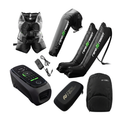
Attachments — Leg boots are the core. Many systems add hip and arm attachments, and some sell them in packages. Decide what you will actually use before buying the complete set.
Compatibility — Check that garments fit the control unit you are buying, and whether they will fit the next one. On one system we carry, the current garments do not fit the previous two generations of control unit. If you ever need a replacement sleeve or an upgrade, that matters.
Garment Warranty — Garments wear faster than control units, and are often warrantied for less. On one brand we carry, the control unit is covered for two years and the garments for one.
04Everyday Use: Power, Portability, Noise and Care
Everyday Use: Power, Portability, Noise and Care
Power — Most systems run from a wall outlet. Some offer a battery pack for use away from one: one system we carry has an optional pack that runs it for up to three hours. Check whether the battery is included or sold separately.
Portability — If you travel with it, check the weight and whether a carrying case is included. One system we carry ships with a 38-liter case.
Noise — The control unit runs a pump for the whole session. If you plan to use it while watching TV or reading in a shared room, ask how loud it is.
Care — Ask how to clean the garments, whether liners or covers are available, and how to store them so the hoses and seams last.
05Delivery, Returns and Warranty
Delivery, Returns and Warranty
Delivery — Compression systems ship by parcel carrier, so there is no freight appointment. Photograph any damage to the carton before opening it. On one system we carry, shipping damage must be reported within 48 hours.
Returns — Garments are worn against the skin, so returns are strict. On one system we carry, returns are accepted within 30 days, new and undamaged only, with a 25 percent restocking fee and return shipping at your cost. Try on the garments carefully and keep the packaging until you are sure.
The Warranty's Fine Print — Read three things:
- 01Control Unit and Garments Separately — Often different lengths. Across the brands we carry: one to two years on the control unit, one year on garments.
- 02Original Purchaser — Coverage usually belongs to the first buyer only.
- 03Who Handles Claims — Directly with the maker, or through the seller? Know before you need it.
06If the System Is Going to Earn Money
If the System Is Going to Earn Money
Compression systems are common in team training rooms, gyms, recovery studios and clinics, where one control unit serves many people a day. That changes the purchase.
The first question is whether the maker warrants the system for commercial use, in writing, and for how long. Many warranties are written for one person at home.
After that:
- Hygiene — Garments are shared skin to skin. Ask about disposable or washable liners, cleaning products the fabric tolerates, and how often garments should be replaced in shared use.
- Sizes on Hand — A team or clinic serves every leg length. Plan to stock more than one garment size, and check they all fit the same control unit.
- Duty Cycle — Ask how many sessions a day the pump is rated for, and how long it can run back to back.
- Claims You Make — If you sell sessions, what you say about them counts. Stay inside the device's cleared indication in your own marketing, and never describe it as treating a condition.
- Clinical Settings — If the system will be used as part of care, ask whether the maker offers a clinical version and what documentation comes with it.
The Questions
Send these to every seller, including us. A good seller answers every one without hesitating.
- 01Is this system FDA cleared, and what is its 510(k) number?
- 02Is the clearance held by this brand, or by the factory that makes it?
- 03What is the cleared indication, word for word?
- 04What pressure range does it run, and can I set pressure chamber by chamber?
- 05How many chambers does each garment have, and what does each mode do?
- 06How are the garments sized, and which size fits my inseam?
- 07Do the garments fit other generations of your control unit?
- 08Does it run on a battery, and is the battery included?
- 09How loud is the pump during a session?
- 10What is the return window, and is there a restocking fee?
- 11How long are the control unit and the garments each warrantied?
- 12For a business: is it warrantied for commercial use, and what do you recommend for hygiene between users?
Ask Every Seller, Including Us
Send these questions to every seller you are considering, including us. If someone else answers them better, buy there.
Keep Reading
- How to Choose a Traditional SaunaReal capacity, heater sizing, electrical, build quality, and buying for a business.
- How to Choose an Infrared SaunaEMF figures, heater types, the circuit you need, cabin or portable, and buying for a business.
- How to Choose a Cold PlungeChiller sizing and cooling time, tub build, water care, delivery, and buying for a business.
- The Recovery Buyer's GuideEvery recovery category, matched to your goal and your space.